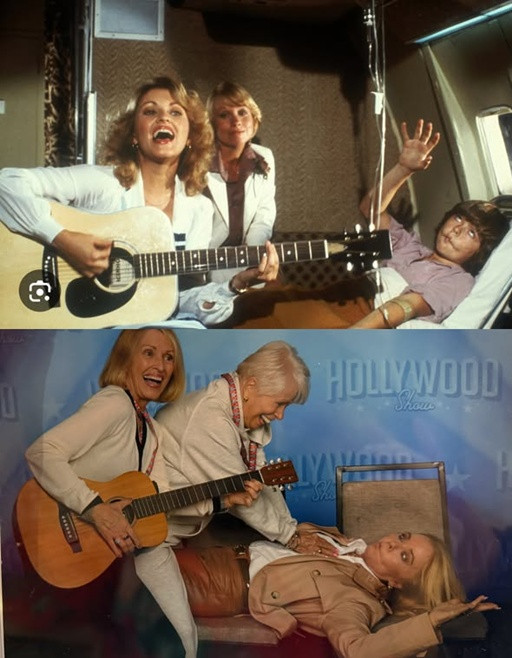
The cast of Airplane reunited at the Hollywood Show this weekend, and there were a lot of fun moments for them all.
Jill Whelan, Joyce Bulifant, and Lorna Patterson took the time to recreate their moment from the 1980 hilarious movie. You know the one where Randy (Patterson) takes out her guitar to play a song for the sick girl (Whelan) on oxygen and her mon (Bulifant). However, the guitar gets stuck on the girl’s tube and cuts off her oxygen. But since all of the passengers are enjoying, they don’t notice that girl can’t breath.
It was funny 46 years ago, and just as funny now. Plus, they all look just as beautiful!
Want to see what they look when they hilariously posed for that photo, then click here!
Happy’s Place is back on NBC tonight at 8p. Isabella (Belissa Escobedo) has been busy with her new speakeasy, and her big sister, Bobbie (Reba McEntire), has a present for her.
What is it? Her own office upstairs. However, she doesn’t want it because she likes sharing one with Bobbie. But Bobbie convinces her to take it.
Since Gabby (Melisa Peterman), Tokoda (Tokala Black), and Steve (Pablo Castelblanco) are all busy helping Isabella, they abandon Bobbie for her recently discovered little half-sister. That means she is alone with Emmett (Rex Linn), whom she recently broke up with.
How awkward will things get between them? You will just have to tune in tonight or starting tomorrow on Peacock.
I am so happy this show is back because it always puts me in a happy place on Fridays. Who doesn’t need that?
Josh Peck was just 17 when Drake & Josh premiered. Jonathan Goldstein, his television father, was 39 then, and that age seemed so far off for the teen.
However, it is 2026, almost 23 years after the family sitcom premiered on Nickelodeon. Guess what? Peck is now 39 years old. The same age Goldstein was in 2004.
When Peck was told that, he declared, “I’m not okay.”
He is not the only one. So are all of us who grew up with the and we are realizing how old we are. Shady Pines, ma!
Tonight at 8:30p, get to know the Newlyweds on NBC. Tim Daly and Téa Leoni are going to play husband and wife for the third time. The first time was on Madam Secretary. Then they did it in real life in July 2025. And now, they are doing it again on the sitcom.
James (Daly) and Jeanie (Leoni) are set up on a blind date, and they immediately click. So much so that she invites him to her place for sex. After a great night of sex, they realize it is more than just that. Even after he meets her grown-up kids, Lolo (Ignacio Diaz-Silverio) and Poppy (Emma Meisel).
However, he is going on a month-long assignment in Norway. Even though they are separated by an ocean, they spend as much time as they can talking on the phone. And their conversations are overheard by James’ assistant, Arvid (Bill O’Neill).
When the month is over, they reconnect in person, and they are so in love. So much so that they declare their love for each other, and he proposes to her. She says yes, and they head over to Las Vegas to tie the knot.
Now the couple, who barely know each other, have to figure out their new lives as husband and wife with her kids, his assistant, and his vengeful ex-wife, Claudia (Jamie Lee Curtis), who is always around.
The chemistry between Daly and Leoni is believable. But then again, how could it not be? While it is there for them naturally, everyone else fits in perfectly. And of course, Curtis steals every scene she is in during this enjoyable sitcom.